
A Range Rover Vogue weighs around two and a half tonnes. A Sport SVR can reach 100 km/h in under five seconds. Stopping that combination — repeatedly, in 45°C heat, in dense traffic — is one of the hardest jobs any component on the vehicle performs. Yet brakes are also the system owners most often economise on, and the UAE market makes it easy to buy parts ranging from excellent to genuinely unsafe under near-identical appearances.
This guide explains how Dubai driving conditions affect Range Rover brake wear, how to read the warning signs correctly, what each brake component does and when it needs replacing, and how to buy braking parts safely in the local market.
Why UAE Driving Is Uniquely Hard on Brakes
Traffic profile. Dubai and Sharjah commuting is defined by repeated hard decelerations — highway speeds interrupted by congestion, speed cameras, and sudden lane changes. Each 120-to-0 stop in a heavy SUV dumps enormous heat into the discs.
Ambient heat. Brakes shed heat to the surrounding air. When that air is 45°C, cooling between stops is slower, operating temperatures climb, and pad material wears faster. Brake fade thresholds arrive earlier.
Vehicle mass and towing. Range Rovers are heavy, frequently loaded, and often towing. Kinetic energy — and therefore brake heat — scales with mass.
Sand and dust. Fine abrasive dust embeds in pad material and accelerates disc scoring. It also works into caliper slider pins, causing sticking calipers that drag, overheat, and wear one pad unevenly.
The practical result: UAE Range Rovers typically consume front pads every 25,000–40,000 km and discs every second or third pad change — noticeably faster than European norms.
Component by Component: What Wears and When
Brake pads. The primary wear item. Modern Range Rovers use electronic wear sensors on at least one wheel per axle, triggering a dashboard warning near the end of pad life. Do not rely solely on the sensor — it monitors one pad position, and a sticking caliper can wear an unmonitored pad to metal first. Have pads measured at every service.
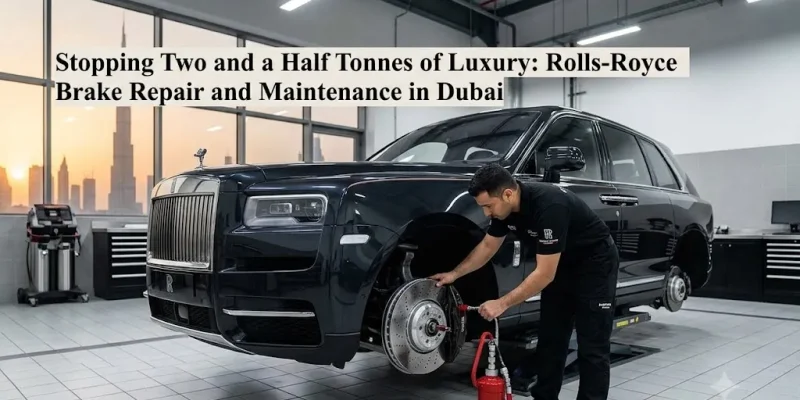
Brake discs (rotors). Discs wear alongside pads and also suffer heat damage. Symptoms of disc problems include steering wheel vibration under braking (disc thickness variation, often from heat), a pulsing pedal, visible lips at the disc edge, and blue heat discolouration. Every disc has a minimum thickness stamped on it; below that figure, replacement is mandatory, not optional. On Range Rovers, discs should always be replaced in axle pairs, with new pads.
Wear sensors. One-time-use items — once the warning has triggered, the sensor has been cut and must be replaced with the pads. Cheap to include, annoying to forget.
Calipers and slider pins. Sticking sliders are common in dusty conditions. Signs: one wheel noticeably hotter than its pair after driving, uneven pad wear side to side, or a faint pull under braking. Slider service kits and, where needed, reconditioned calipers are readily available locally.
Brake fluid. Hygroscopic and heat-stressed. Old fluid lowers the boiling point and produces the classic long-pedal feel in summer stop-and-go. Change every two years in this climate without exception, and always after any caliper work.
Electronic park brake components. Various Range Rover generations use EPB actuators that wear and occasionally fail — a familiar job for local specialists, with parts well stocked.
Carbon-ceramic systems (SVR and special editions). These follow their own inspection regime and their own budget. If you own one, use workshops with specific experience — measurement is by weight and inspection, not thickness alone.
Reading the Warning Signs Correctly
- Squealing: often the mechanical wear indicator contacting the disc — pads due now.
- Grinding: metal on metal. Stop driving; discs are being destroyed with every application.
- Vibration under braking only: disc thickness variation or heat spots — discs and pads, and check calipers for the cause.
- Vibration under acceleration or at steady speed: usually not brakes — think wheels, driveshafts, or mounts — but a dragging caliper can mimic it; a hot-wheel check after driving distinguishes them.
- Soft or long pedal: fluid condition, air in the system, or a master cylinder issue — safety-critical, diagnose immediately.
- Pulling to one side while braking: sticking caliper or contaminated pad on the opposite side.
- Brake warning lights: read the code. Modern Range Rovers distinguish pad wear, fluid level, EPB faults, and ABS issues — each has a different urgency.
Choosing Brake Parts in the UAE Market: The Non-Negotiables
Braking is the one system where the unbranded copy market must be avoided entirely. Counterfeit and no-name pads with inconsistent friction material are documented causes of fade and dramatically extended stopping distances — invisible in the box, decisive in an emergency stop on Sheikh Zayed Road.
Safe tiers for Range Rover braking:
- Genuine Land Rover pads and discs — premium price, guaranteed performance.
- Original-supplier OEM: Brembo, TRW, ATE, Textar, and Ferodo supply JLR and the wider premium market; their catalogue parts frequently match or exceed genuine specification at 30–50% less.
- Performance upgrades: for hard-driven Sports and SVRs, drilled/slotted disc and high-temperature pad options from the same reputable brands manage heat better in Gulf conditions.
Buy from established specialists who can verify part numbers against your VIN — Range Rover brake specifications vary by engine, wheel size, and option pack even within one model year, and 380 mm and 350 mm discs do not forgive guesswork. Dedicated stockists serving the range rover spare parts dubai market hold genuine and OEM braking lines for every generation, with wear sensors, hardware kits, and fluid in stock alongside — so the job is done once, completely.
A Sensible Brake Maintenance Routine
- Measure pads and discs at every oil service — numbers, not glances.
- Change fluid every two years, tested annually for moisture.
- Service caliper sliders at each pad change — five minutes that prevents the most common UAE brake fault.
- Replace discs in pairs with new pads and sensors; bed the new components in gently for the first 300 km.
- After desert driving, rinse wheels and check for embedded stones between pad and disc.
Owners in the northern emirates enjoy the same access to quality braking components through the Sharjah trade; established suppliers of range rover parts dubai workshops depend on deliver across the UAE daily, so there is never a good reason to fit an unknown brand to a heavy, fast SUV.
Final Word
Brakes convert your Range Rover’s speed into heat, and UAE conditions supply more speed, more mass, and more heat than almost any market on earth. Respect the wear rates, act on symptoms early, insist on recognised brands, and buy against your VIN from the specialist trade. It is the cheapest life insurance a two-and-a-half-tonne SUV can carry.