

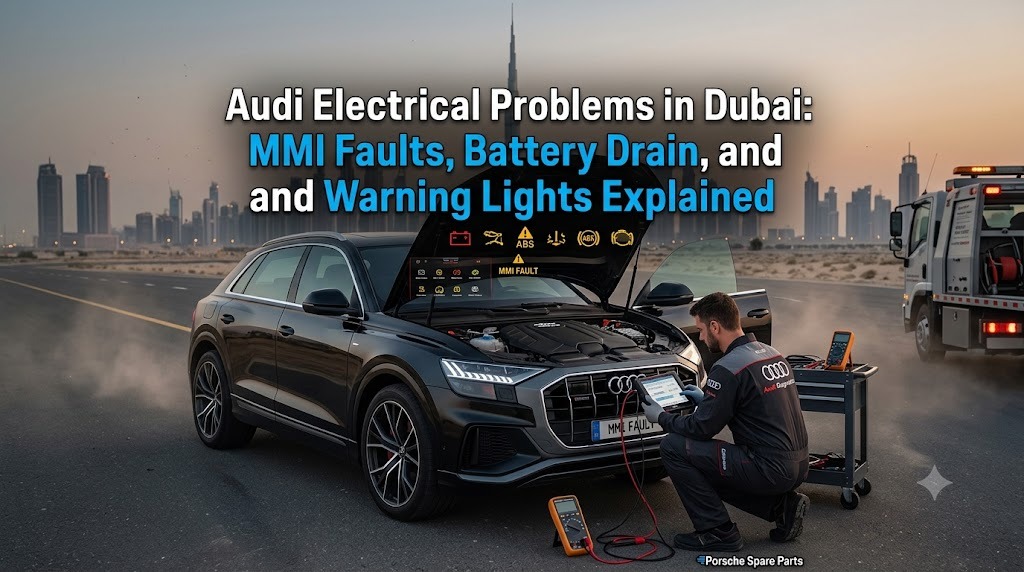
A modern Audi is as much a computer network as it is a car. An A6 or Q8 carries dozens of electronic control modules communicating over multiple data buses, virtual cockpit displays, capacitive touchscreens, radar sensors, cameras, and enough software to make a laptop blush. When it all works, the experience is superb. When something glitches, owners face mysterious warning lights, screens that reboot mid-journey, and batteries that die overnight — and in Dubai’s heat, electronics fail more often than the brochure suggests.
This guide covers the electrical problems Audi owners in the UAE encounter most, what causes them, and how a proper diagnostic approach saves both money and frustration.
Why Heat Is Brutal on Car Electronics
Electronic components are rated for temperature ranges, and a car parked in the Dubai sun pushes past them routinely. Cabin temperatures above 70°C bake display adhesives, stress solder joints through expansion and contraction, dry out capacitors, and harden wiring insulation until it cracks. Under the bonnet it’s worse. Add coastal humidity that encourages corrosion on connectors, and you have an environment that ages a car’s electrical system at perhaps twice the rate of a European climate.
Problem 1: Battery Drain and Short Battery Life
The complaint: the car struggles to start after sitting for two or three days, or the battery is simply dead.
Heat is the first culprit. UAE battery life runs 24–36 months against 4–5 years in Europe; heat accelerates the internal chemical degradation regardless of how you drive.
Parasitic drain is the second. Audis put their modules to “sleep” a few minutes after locking. A faulty module that keeps waking the network — commonly an infotainment component, a door module, or an aftermarket accessory wired incorrectly — can pull enough current overnight to flatten a healthy battery. Diagnosing this requires a controlled parasitic draw test, measuring current at the battery while systematically identifying which circuit refuses to sleep. It’s methodical work, not guesswork.
Two things every owner should know: first, a weak battery causes false faults across the car — low system voltage makes unrelated modules log errors and light up the dash like a Christmas tree, so battery testing is always step one of any electrical diagnosis. Second, Audi batteries must be coded to the vehicle when replaced. The energy management system tailors charging to the battery’s age and specification; skip the coding and the new battery will be chronically undercharged and die early.
Problem 2: MMI Freezes, Reboots, and Blank Screens
Audi’s MMI infotainment — from the rotary-dial versions in older models to the dual-touchscreen MIB systems in current cars — generates a familiar list of complaints: frozen screens, spontaneous reboots, lost Bluetooth pairing, unresponsive touch input, and blank displays.
Software is the cause more often than hardware. Many faults are cured by a forced MMI restart (on most models: hold the volume knob/button and designated keys — a workshop can show you the combination for your car) or by updating the MMI firmware to the latest release. Persistent faults after updates point to hardware: failing main units, fibre-optic MOST bus ring breaks (one failed component in the ring — an amplifier, a tuner — can take down the entire infotainment system), or heat-damaged displays. Proper diagnosis of a MOST ring requires specific test equipment to find which module has broken the loop; replacing parts on suspicion gets expensive fast.
Problem 3: Warning Light Cascades
The steering wheel light, ABS light, and stability control light all illuminate together. Is the car falling apart? Usually not — the systems share sensors and data, so one failed wheel-speed sensor or a low battery voltage event can trigger a cascade of related warnings. The correct response is a full-system scan with factory-level software (ODIS or VCDS), reading fault codes with their freeze-frame data — the snapshot of conditions when the fault occurred. That freeze frame is what separates “sensor failed at highway speed, intermittently, when hot” from wild guessing.
Never pay for parts based on a generic code reader’s one-line description. “16352 — Control Module Fault” has sent many owners shopping for modules when the real issue was wiring or voltage.
Problem 4: Door Locks, Windows, and Small Actuators
Central locking actuators that click but don’t lock, windows that forget their one-touch position, mirrors that stop folding — these small electromechanical parts suffer directly from heat-hardened lubricants and baked plastic gears. Window regulators on older A4/A6 models are a classic wear item. Most of these repairs are inexpensive individually; the skill is in accessing them without breaking heat-brittled interior trim clips, which is genuinely a concern on cars that have lived in the Gulf sun.
Problem 5: Wiring, Connectors, and Aftermarket Installations
Cracked insulation in high-flex areas (door jambs, tailgate looms) causes intermittent faults that appear and vanish with temperature — the hardest category to diagnose. Tailgate wiring breaks are common on Audi Avants and SUVs: rear wiper, camera, and lock faults that come and go. And a special mention for aftermarket accessories: poorly installed dashcams, trackers, and audio systems tapped into convenience circuits are behind a remarkable share of battery drain and network faults seen in UAE workshops. If an accessory was fitted and problems started afterwards, say so — it shortens the diagnosis considerably.
The Right Diagnostic Approach
Audi electrical work rewards method and punishes parts-swapping. The professional sequence: test and verify the battery and charging system first; scan all modules and record freeze-frame data; check for available software updates; then trace the specific circuit with wiring diagrams and oscilloscope or multimeter testing before any component is condemned. A well-equipped audi garage dubai facility with ODIS-level software, MOST bus test tools, and technicians who work on these systems daily will routinely solve in hours what trial-and-error approaches drag out over weeks — and several battery-and-module replacements.
Electrical gremlins feel mysterious, but they rarely are. With the right tools, current wiring diagrams, and a systematic process, even intermittent faults get found. Keep your battery healthy, keep the software updated, be cautious with aftermarket installations, and your Audi’s impressive electronics will stay on your side — even through a Dubai summer.