
BMW built its reputation on how its cars drive — the steering precision and body control that made “the ultimate driving machine” more than a slogan. That character depends on a suspension system engineered to tight tolerances, and it is exactly those tight tolerances that make BMWs communicate wear so clearly. Where another car grows vaguely soggy over the years, a BMW develops specific clunks, shimmies, and wandering habits that owners in the UAE often live with for far too long, assuming they are the price of speed bumps and age. Most of them are inexpensive to fix and transformative when done — and a few are genuine safety items hiding behind a familiar noise.
Why the Gulf Is Hard on Suspension
At first glance, Dubai should be easy on suspension: the highways are smooth and winters do not exist, so there is no salt corrosion or pothole season. The reality is more punishing than it looks. The suspension’s rubber components — bushings, mounts, boots, and bump stops — suffer the same heat-ageing as every other elastomer on the car, hardening and cracking years ahead of the European schedule. Speed bumps, which the region deploys in extraordinary density, hammer front control arms and strut mounts with exactly the kind of vertical impact they dislike most. Kerb strikes during parking, ubiquitous in tight residential and mall parking, quietly bend tie rods and knock wheels out of alignment. Fine sand works into ball joint boots the moment they crack, turning a protective grease pocket into grinding paste. And the loads are real: highway speeds are high, cars are heavy, and SUV-heavy fleets stress components hardest.
The Front End: Where BMW Wear Concentrates
BMW’s front suspensions — double-pivot strut designs on most sedans, double wishbone on the larger SUVs — use multiple control arms per side, each with bushings and ball joints. The wear hierarchy is remarkably consistent:
Thrust arm (tension strut) bushings. The hydraulic-filled bushings on the forward lower arms are the classic first failure on nearly every BMW platform. When they wear, the symptom is unmistakable once you know it: a shimmy or shudder through the steering wheel under braking from highway speed, often misdiagnosed as warped brake discs. Many owners in the UAE have paid for new discs twice before anyone checked the thrust arms. The bushings are engineered to be soft for comfort, which is precisely why they wear; heat-hardened and cracked, they let the wheel move fore-aft under braking loads.
Ball joints and outer tie rod ends. Once a boot cracks — and heat guarantees boots crack — sand ingress finishes the joint quickly. Symptoms are knocking over small bumps, vague steering on-centre, and uneven inner tyre wear. A torn boot found at service is a repair-now item, not a monitor item, in this environment.
Strut top mounts. The rubber-and-bearing assemblies at the top of each strut take every speed bump personally. Worn mounts creak or clunk during slow parking-lot steering and over bumps, and can add a rubbery vagueness to turn-in.
Anti-roll bar links and bushings. The cheapest parts on the car and the source of a disproportionate share of its rattles — a hollow clonk over broken pavement that makes an otherwise tight car feel old. Fifteen-minute fix per side on most models.
Dampers, Adaptive Systems, and Air Suspension
Conventional dampers rarely fail dramatically; they fade. The car develops float over highway undulations, nose-dive under braking, and a busy secondary ride the owner attributes to tyres. In this climate, damper oil runs hot and seals age, and 100,000–130,000 km is a realistic service life. The test is comparative: drive a car with fresh dampers back-to-back and the difference is startling.
BMW’s adaptive dampers (EDC) add electronics to the equation — a failed damper or its wiring throws a chassis fault and defaults the system to a fixed mode. Owners often notice only that the car rides worse, not that a light is on.
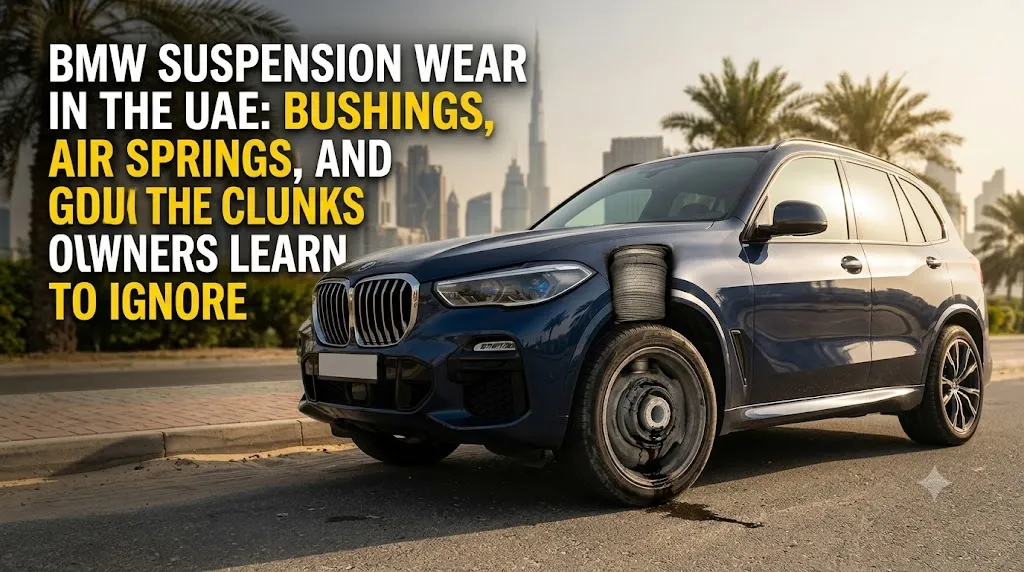
Air suspension deserves its own paragraph, because the X5, X7, and 7 Series that carry it are pillars of the UAE market. The air springs are rubber bellows; heat cracks them exactly as it cracks every other rubber part, typically starting as fine crazing at the fold. The pattern is universal: the car sits perfectly overnight in mild months, then begins settling on one corner after hot days, then overnight, then within hours. Meanwhile the compressor works ever harder to compensate, running hotter and longer until it burns out — which is why the golden rule of air suspension is fix the leak before it kills the compressor. A car sagging on one corner in the morning has a leak, full stop, and every week of delay transfers cost from a spring to a spring plus a compressor.
Alignment: The Cheapest Handling Upgrade Nobody Does
Every kerbed wheel, every enthusiastic speed bump, every worn bushing nudges alignment away from specification. Symptoms accumulate slowly: a steering wheel a few degrees off-centre, a car that follows road camber, front tyres feathered on the inside edge. On a BMW, whose steering feel is the whole point, misalignment is felt more than on most cars — and it eats tyres, which at UAE summer temperatures are already working hard. A proper four-wheel alignment on BMW-specific settings, done after any suspension repair and annually regardless, is among the best value services in motoring. It is worth insisting the workshop loads the car per BMW’s specification where required and checks thrust angle, not just front toe — a quick “toe and go” leaves half the geometry wrong.
Reading Your Car’s Complaints
A rough translation guide for the noises UAE BMW drivers learn to ignore: a single clunk over speed bumps points to anti-roll bar links or top mounts; steering shimmy under braking points to thrust arm bushings before it points to discs; knocking on full-lock parking manoeuvres suggests top mounts or, on some models, front axle joints; a rhythmic droning that changes with speed but not engine revs is a wheel bearing — accelerated locally by heat and heavy SUVs; rear-end clunks on bumps in an X5 or 7 Series warrant checking air spring mounts and rear arm bushings. None of these diagnoses is certain from sound alone, which is why a proper assessment combines a road test with the car on a lift, levering each joint under load. Guessing by parts-cannon — replacing components until the noise stops — is the expensive way to arrive at the same answer.
The difference between a general workshop and a marque-focused one is largest exactly here, in chassis work: knowing that a particular platform’s braking shimmy is thrust arms, that a specific model needs alignment loaded, that a torn boot in this climate is urgent. If your BMW has developed a clunk you have been ignoring, is eating front tyres, or sits low on one corner in the morning, a thorough chassis inspection at a well-equipped bmw garage dubai will map the wear precisely — usually revealing that the fix is far cheaper than the noise suggested, and occasionally revealing the one item that genuinely should not wait.
Conclusion
Suspension wear is the most gradual deterioration a car experiences, which is why it is the most under-repaired. No warning light announces a tired bushing; the car simply becomes, month by month, a slightly worse version of itself until the owner forgets what it once felt like. In the Gulf, heat compresses that timeline dramatically. The reward for staying ahead of it — fresh bushings, healthy dampers, honest alignment — is not just safety and tyre life, but the rediscovery of the very thing that made the car worth buying: a BMW that drives like a BMW again.