

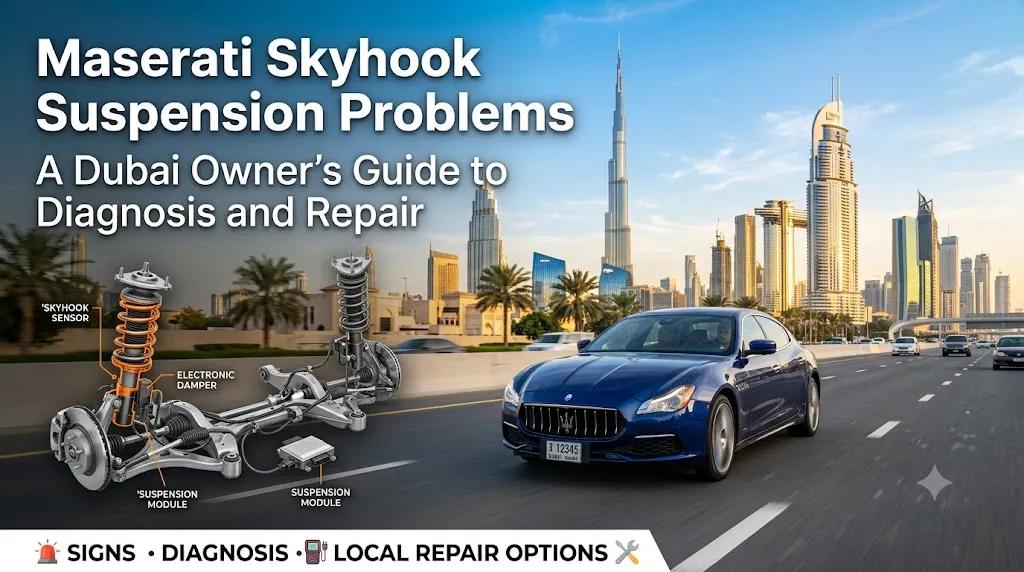
One of the qualities that separates a Maserati from ordinary luxury sedans is the way it rides. The Quattroporte glides over broken tarmac yet corners flat when pushed; the Levante manages to feel athletic despite SUV height and weight. Much of this dual personality comes from Skyhook — Maserati’s adaptive damping system, which continuously adjusts each shock absorber many times per second based on road surface, speed, and driving style.
When Skyhook is healthy, it is one of the best suspension systems fitted to any car. When it fails, owners face a warning message on the dash, a ride that turns either harsh or wallowy, and — at the dealer — a repair quote that can genuinely shock. This guide explains how the system works, why it fails in UAE conditions, the symptoms to watch for, and the realistic repair options available to Dubai owners.
How Skyhook Actually Works
Traditional dampers are a fixed compromise: firm enough for control, soft enough for comfort, good at neither extreme. Skyhook replaces the fixed valving with electronically controlled dampers filled with fluid whose flow is regulated by a solenoid valve on each shock absorber. Accelerometers on the body and wheels feed a control module that calculates, in real time, how much damping each corner needs — soft over a sharp bump, firm under hard cornering or braking.
The system’s components are therefore:
- Four electronic dampers with integrated solenoid valves
- Body and wheel acceleration sensors
- A dedicated suspension control module
- Wiring connecting all of the above, routed partly under the car
Every one of these components is a potential failure point, and Dubai conditions attack several of them specifically.
Why Skyhook Fails Faster in the Gulf
Heat degrades damper fluid and seals. The hydraulic fluid inside each damper thins at high temperature, and seals harden after years of 45°C+ ambient heat plus the heat generated by the damping itself. Hardened seals begin to weep fluid — and a Skyhook damper that has lost fluid can no longer generate its designed range of damping force. You will often see the evidence as an oily film on the damper body.
Speed bumps hammer the hardware. Dubai communities are dense with speed bumps, and repeated compression cycles — especially taken too fast — fatigue damper internals and mounting bushings far quicker than smooth-road driving.
Dust and moisture attack connectors. The electrical connectors at each damper live in the wheel arch environment: sand blast, water from undercarriage washing, and humidity. Corroded or contaminated connectors cause intermittent faults that light the dashboard warning even when the dampers themselves are healthy.
Voltage sensitivity. Like most Maserati systems, the suspension module dislikes the voltage sags of a heat-weakened battery. A surprising number of “Suspension Failure” messages in Dubai trace back to a dying battery rather than the suspension at all.
Symptoms: What Owners Actually Notice
- The warning message. “Suspension Failure — Go to Dealer” or similar on the instrument cluster, sometimes intermittent at first, appearing on hot afternoons and clearing overnight.
- Ride quality change. With a failed damper or a system in fallback mode, the car typically defaults to a fixed damping level. Owners describe it as “crashy over bumps” or, with a leaking damper, “floaty and bouncy — it keeps rocking after a speed bump.”
- Knocking or clunking. A damper with worn internals or a failed top mount knocks over sharp bumps. In Dubai this often gets misdiagnosed as anti-roll bar links (which do also wear here) — proper inspection distinguishes them.
- Uneven tyre wear. A corner with weak damping lets the wheel patter over surfaces, scalloping the tyre. If one tyre wears strangely, suspect the damper behind it.
- Nose dive or squat. Excessive pitch under braking or acceleration indicates the system is no longer firming the appropriate dampers.
Diagnosis: The Difference Between Guesswork and Knowledge
Skyhook faults must be diagnosed electronically first. Factory-capable diagnostic equipment can read the suspension module’s fault memory, show live damper current values, and command each solenoid individually — instantly revealing whether the problem is one damper, a sensor, wiring, the module, or simply low system voltage. Combined with a physical inspection (fluid leaks on damper bodies, bounce testing, connector condition, top mounts), an experienced technician can pinpoint the failed component precisely.
This matters enormously because of the cost spread. A corroded connector is a trivial repair. A single leaking damper is a significant but contained job. Being told “replace all four dampers and the module” when one connector was at fault is the kind of outcome that proper diagnosis exists to prevent. When your dashboard shows a suspension warning, insist on a documented diagnostic process before any parts are ordered — reputable providers of maserati repair dubai will show you the fault codes, the live data, and the physical evidence before recommending a repair path.
Repair Options: Dealer, Specialist, and the Conversion Question
Genuine damper replacement. The gold standard: original electronic dampers restore the car exactly to factory behaviour. Dampers should ideally be replaced in axle pairs so left and right behave identically. The dealer route carries the highest parts pricing; independent specialists can often source the same genuine or OEM-supplier units at meaningfully lower cost.
Quality aftermarket electronic dampers. For some models, OEM suppliers sell the equivalent damper under their own brand at a lower price. Same part, different box — a legitimate saving when sourced carefully.
Passive conversion kits. Some owners of older, high-mileage cars consider converting to conventional non-electronic dampers with resistor modules to silence the warnings. It is cheaper up front, but you permanently lose the adaptive ride that defines the car, and resale-conscious buyers notice. For a cherished Maserati, we generally advise keeping Skyhook alive; for an aging car near the end of its Dubai life, conversion can be a pragmatic choice. An honest workshop will lay out both paths rather than pushing one.
Protecting Your Skyhook System
- Slow right down for speed bumps — the single biggest factor in damper life here.
- Wash the underbody and wheel arches periodically to clear sand from connectors and damper bodies.
- Have dampers visually checked for weeping at every service.
- Keep the battery healthy; test it every service.
- Investigate warnings early — one failed damper overworks the other three.
Skyhook is a system worth preserving. It is a large part of why a Maserati feels like a Maserati, and with climate-aware maintenance and accurate diagnosis when faults appear, it can be kept healthy for the life of the car — without dealer-level invoices every time a warning light appears.