
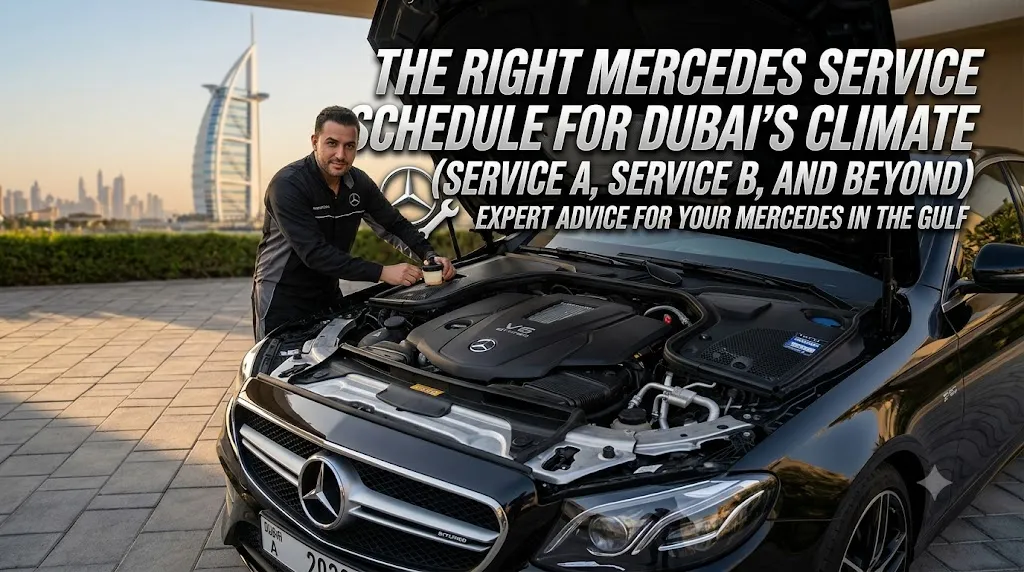
Open the maintenance booklet of any Mercedes-Benz and you’ll find a tidy schedule: Service A at around 15,000 km or one year, Service B at 30,000 km or two years, alternating thereafter, with additional items layered in at set intervals. It is a sensible plan — for Germany. Dubai is a different planet as far as your car is concerned: sustained 45°C+ ambient temperatures, engine bays soaked in heat for six months a year, airborne dust that clogs filters at twice the European rate, stop-and-go traffic on Sheikh Zayed Road, and short air-conditioned hops that never let the engine oil fully do its job. Follow the European schedule to the letter in this environment and you will quietly shorten your car’s life.
This guide explains what Service A and Service B actually include, and how a Gulf-aware schedule differs from the book.
What Service A and Service B Actually Cover
Service A is the smaller of the two. It centres on an engine oil and filter change using the correct Mercedes-approved specification (MB 229.5, 229.52, or 229.71 depending on engine), fluid level checks and corrections, tyre pressure and condition check, brake inspection, and a reset of the maintenance counter. Think of it as the essential health check.
Service B includes everything in Service A and adds the cabin dust/combination filter, brake fluid replacement (hygroscopic fluid absorbs moisture and must be renewed roughly every two years), and a deeper inspection of the vehicle’s mechanical systems — suspension components, driveshafts and boots, exhaust, lights, wipers, and body drains.
Beyond A and B, Mercedes prescribes interval-based additions: engine air filters, spark plugs, transmission fluid and filter on many gearboxes, coolant renewal, fuel filters on diesels, and rear axle/transfer case oils on 4MATIC models. These “extras” are precisely where Dubai conditions demand the biggest adjustments.
How Dubai Changes the Math
Engine oil: shorten the interval. Heat oxidises oil. Extended idling in traffic with the AC compressor loaded, plus short journeys where oil temperature spikes, degrade the oil’s additive package well before 15,000 km. The prudent Gulf interval is 10,000 km or six months, whichever comes first — and even more conservative for AMG models or cars that see track days or towing. Fresh oil is the cheapest insurance in motoring; nothing else on this list matters if lubrication is compromised.
Air filters: check twice as often. Desert dust loads the engine air filter and the cabin filter far faster than European dirt. A choked engine filter costs power and fuel economy; a choked cabin filter cuts AC airflow exactly when you need it most and lets fine dust into the evaporator. Sensible Dubai practice is to inspect both at every service and expect replacement roughly every 15,000 km rather than 30,000.
Coolant: respect the interval, verify the condition. The cooling system runs closer to its limits here than anywhere in Europe. Coolant’s corrosion inhibitors deplete over time, and depleted coolant attacks the water pump, radiator, and heater core from the inside. Have concentration and condition tested annually and renew per schedule with genuine MB 325.0/326.0-approved antifreeze — never topped up with plain water beyond an emergency.
Transmission fluid: ignore “lifetime fill.” Whatever the marketing once said, the 7G-Tronic and 9G-Tronic gearboxes in Gulf service benefit enormously from fluid and filter changes every 60,000 km. Heat is the primary ager of ATF, and Dubai supplies heat in abundance. A AED 1,200–1,800 fluid service is trivial next to a valve body or torque converter repair.
Brake fluid and brakes: heat again. Stick rigidly to the two-year brake fluid interval — moisture-laden fluid boils under hard braking, and heat accelerates absorption. Expect brake pads and discs to wear somewhat faster than European norms due to heavier traffic braking and higher operating temperatures.
Battery: plan for a short life. Accept that an AGM battery in Dubai is a two-to-three-year consumable, not a five-year one. Have it load-tested at every service after the second year. Because modern Mercedes electronics misbehave in strange ways on weak voltage, proactive replacement prevents a season of phantom warning lights — and remember that a new battery must be registered to the car’s energy management system, not merely swapped.
AC system: make it a scheduled item. In the Gulf, the climate system deserves formal inclusion in the annual schedule: refrigerant pressure check, condenser fin cleaning (bugs and dust insulate it), drain tube clearing, and an evaporator antibacterial treatment to prevent the musty smell endemic to hot, humid climates.
A Practical Gulf Schedule at a Glance
A workshop experienced in mercedes service dubai conditions will typically recommend a rhythm like this: every 10,000 km or 6 months, an oil service with full inspection; every 20,000 km, add engine and cabin filters as needed plus AC performance check; every 2 years, brake fluid without fail; every 60,000 km, transmission fluid and filter, spark plugs per engine type, and coolant condition service; annually before summer, a dedicated pre-summer check of battery, cooling system, and air conditioning. The exact plan should flex with your model, engine, and usage — a chauffeur-driven S-Class idling at hotel entrances needs different care from a weekend-driven SLC — which is exactly why a workshop that knows your car’s history beats a transactional service counter.
The Service Indicator Isn’t Gospel
Mercedes’ ASSYST Plus counter estimates service due dates from time, mileage, and some driving inputs — but it does not measure oil condition, does not know about dust storms, and assumes European fuel and climate. Treat the dash reminder as a maximum limit, not a target. Servicing before the counter demands it is never wrong in this climate; stretching past it usually is.
Records Protect Your Money Twice
Every dirham spent on maintenance returns value twice: once in reliability, and again at resale. UAE buyers pay real premiums for documented history. Insist on detailed invoices listing the VIN, mileage, oil specification, and parts fitted, and keep them together. When you eventually sell, that folder transforms your car from “another used Merc” into a verified, cared-for example — often worth thousands more.
The Takeaway
Mercedes-Benz builds cars capable of three hundred thousand kilometres and more, and plenty of Dubai taxis and family cruisers prove it — but only when maintenance acknowledges the environment. Shorten the oil interval, double the attention to filters and cooling, treat the battery and AC as scheduled items, and never let “lifetime” fluids live a Gulf lifetime. Do that, and Service A and Service B stop being expenses and become the reason your Mercedes still feels magnificent a decade from now.