
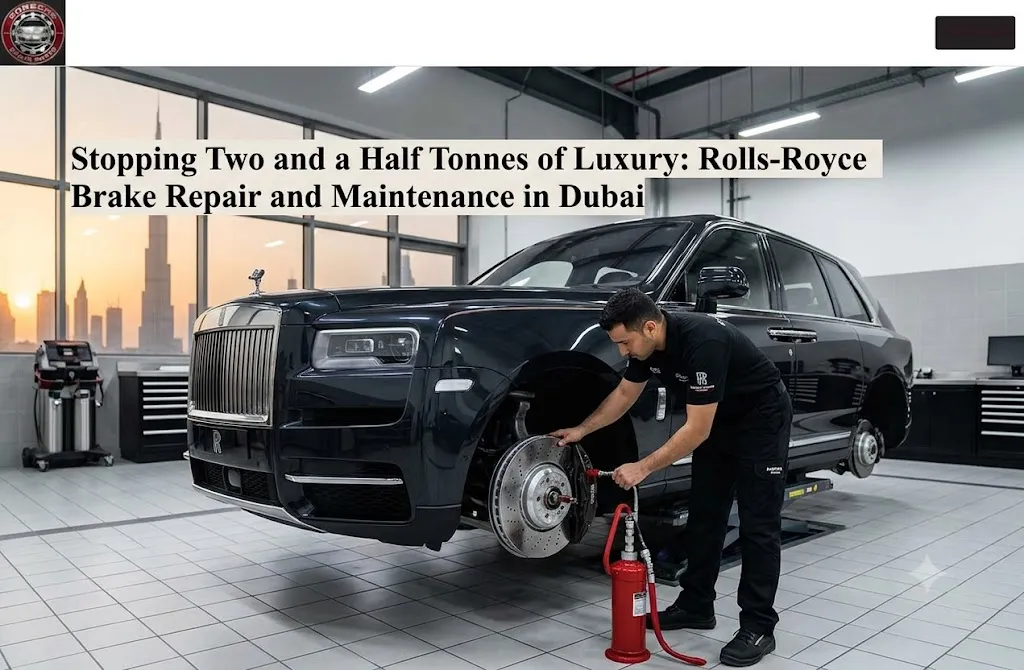
A Rolls-Royce Cullinan weighs around 2,660 kg before passengers. A Phantom is not far behind. These are among the heaviest passenger cars on the road, capable of reaching highway speeds with deceptive ease — the cabin is so isolated that 140 km/h feels like 80. All of that mass and velocity must be managed by the brake system, which makes brakes arguably the single most safety-critical maintenance item on any Rolls-Royce, and one where the Dubai driving environment imposes unique demands.
This article covers how the braking system on modern Rolls-Royce models works, the wear patterns and faults common in the UAE, and what distinguishes a proper brake repair from a merely adequate one.
The Hardware: Built for the Job
Rolls-Royce fits appropriately enormous brakes. Depending on model, front discs approach or exceed 400 mm in diameter, clamped by multi-piston calipers, with ventilated and drilled discs designed to shed heat quickly. Supporting the hardware is a suite of electronics: multi-channel ABS, electronic brake-force distribution, stability control, brake assist that detects emergency applications, automatic hold functions, an electronic parking brake, and integration with driver-assistance systems that can apply the brakes autonomously.
The system is superb — but every element of it is a wear item or a service item, and the Gulf accelerates several of them.
How Dubai Driving Wears Rolls-Royce Brakes
Stop-start traffic with high vehicle mass. The daily rhythm of Dubai traffic — repeated braking from moderate speeds, minimal cooling airflow between stops — is close to a worst-case duty cycle for pads and discs. Heavy cars in stop-start conditions consume friction material fast. It is entirely normal for a Cullinan driven mainly in city traffic to need front pads noticeably sooner than the same car doing highway kilometres.
Heat soak. Braking converts motion into heat, and in summer the system starts each journey pre-heated to 50°C. Repeated hard stops can push disc temperatures into ranges where pad material glazes — the friction surface crystallises into a hard, shiny layer that reduces bite and produces squealing. Glazed pads feel like a longer, softer pedal and are frequently misdiagnosed.
Brake fluid degradation. This is the silent one. Brake fluid is hygroscopic — it absorbs moisture from the air — and Dubai’s coastal humidity accelerates the process. Moisture lowers the fluid’s boiling point; under hard use, water in old fluid can vaporise, and vapour compresses where fluid does not. The result is the terrifying long pedal known as brake fade. Fluid that tests fine in Europe at three years can be badly compromised here at two. In the Gulf, brake fluid should be tested annually and changed every two years without exception.
Dust and corrosion. Fine desert dust works into caliper slide mechanisms and past piston seals. Combined with humid salt air, it causes pistons and slides to stick — the cause of most uneven pad wear, pulling under braking, and that faint hot-brake smell after a drive.
Parking brake issues on low-use cars. Many Rolls-Royces in Dubai cover low mileages with long stationary periods. Electronic parking brake actuators and rear caliper mechanisms seize from disuse; the first sign is a grinding or groaning on release, or a parking brake fault message.
Symptoms That Demand Immediate Attention
- Longer or softer pedal travel — fluid moisture, air in the system, or a hydraulic fault. Never ignore this.
- Vibration through the pedal or steering when braking — disc thickness variation, usually from heat or uneven pad transfer. On a car engineered for total smoothness, even mild judder is glaring.
- Pulling to one side under braking — a sticking caliper on the opposite side, or contaminated pads.
- Squealing or grinding — glazing, worn-out pads, or debris. Grinding means metal contact and immediate inspection.
- Any brake warning message. The car monitors pad wear electronically and reports hydraulic and electronic faults precisely. The message is never wrong enough to ignore.
- ABS or stability control lights — often a wheel-speed sensor contaminated by dust or a damaged sensor ring, but the effect is degraded emergency braking.
What a Proper Rolls-Royce Brake Repair Involves
The difference between a specialist brake job and a quick pad swap is substantial, and on a car of this weight it matters.
Measurement, not assumption. Discs are measured with a micrometer at multiple points for thickness and run-out against factory limits. A disc below minimum thickness cannot safely absorb heat and must be replaced — resurfacing below spec is not an option on these cars.
Correct friction components. Rolls-Royce brake pads are engineered for a specific friction coefficient, heat range, and — critically for this brand — noise and dust behaviour. Budget pads on a Phantom announce themselves with squeal and heavy black dust on those large polished wheels, and their bite characteristics change the pedal feel owners paid for. Genuine or original-equipment-manufacturer pads and discs are the only appropriate choice.
Caliper service, not neglect. Every proper brake job includes cleaning and lubricating slide mechanisms with high-temperature grease, inspecting piston boots for splits, and verifying that every piston retracts freely. In Dubai’s dust, this step is what prevents the next set of pads wearing unevenly.
Fluid work done correctly. A full fluid exchange on a modern Rolls-Royce requires diagnostic equipment to actuate the ABS/stability control pump so old fluid is purged from the hydraulic unit — not just the lines. A gravity bleed at a general garage leaves the most critical fluid in the car untouched.
Electronic integration. Pad wear sensors must be replaced and the service system reset. Electronic parking brake work requires putting the actuators into service mode via diagnostics; forcing rear pistons back without it destroys the actuators. After certain repairs, the brake system requires calibration road-testing to bed components and verify electronic function.
Bedding-in guidance. New pads and discs need a correct bedding procedure — a series of progressive stops — to establish an even transfer layer. A good workshop performs the initial bedding and explains the first 300 km to the owner.
Choosing Where the Work Is Done
Brakes are one area where the choice of workshop is genuinely a safety decision. The combination of the vehicle’s mass, the electronic integration of its braking system, and the specific procedures required means the work belongs in expert hands. Owners looking for a trusted rolls royce garage dubai should confirm three things before handing over the keys: that the workshop uses factory-level diagnostic equipment capable of servicing the electronic brake systems, that it fits genuine or OEM friction components and can show you the parts, and that fluid exchanges are performed with the pressure-bleeding and ABS-actuation procedure the car requires.
An Owner’s Brake Care Checklist for the Gulf
- Test brake fluid moisture content every year; replace every two years.
- Have pads, discs, and calipers inspected at every service — measured, not glanced at.
- After a spirited drive, avoid holding the brakes clamped at a standstill while they are very hot; it imprints pad material on the discs and starts judder.
- Use the parking brake regularly, even on automatic cars, to keep the mechanism free.
- Wash the wheels and calipers periodically to clear abrasive dust.
- Treat the first sign of vibration, pull, or noise as a booking, not background noise.
A Rolls-Royce should stop the way it accelerates: silently, immediately, and without drama. Maintained correctly, the braking system delivers exactly that for the life of the car — even in the hardest climate it will ever face.