Does Porsche Share Parts With Volkswagen? What Is Shared and What Fits
The model-by-model Volkswagen Group family tree, how to read a Porsche part number, and when a VW-numbered part is a sensible buy.
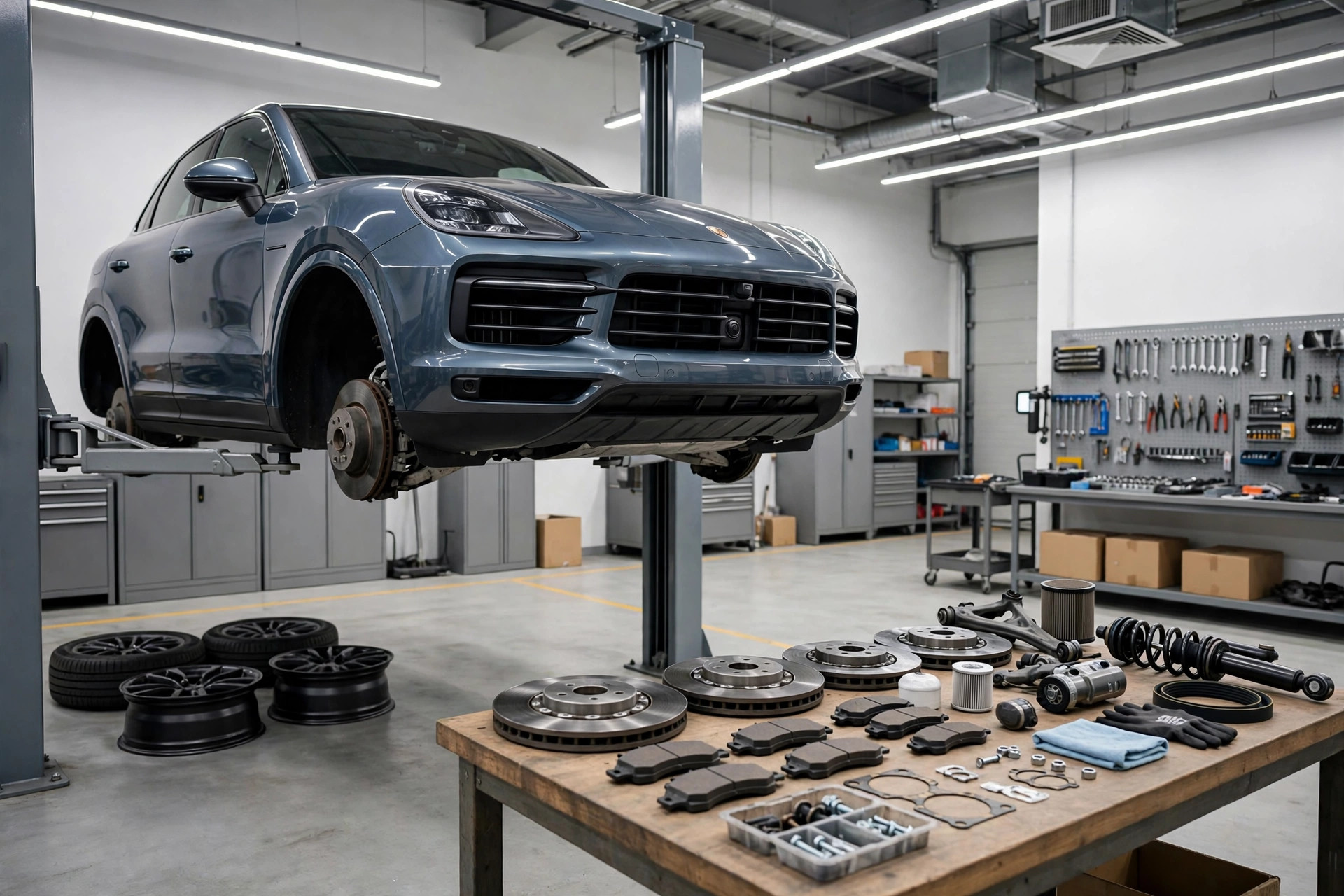
Does Porsche share parts with Volkswagen? Yes, but only on some models. The Cayenne, Macan, Panamera and Taycan are built on Volkswagen Group platforms shared with VW, Audi, Bentley or Lamborghini models, while the 911 and 718 use Porsche’s own engineering.
So does Porsche use VW parts? On shared-platform models, many hidden components are Group parts, and the part number tells you which. Below is the model-by-model picture, then how to read a part number and when a VW-numbered part is a sensible buy.
Quick answer
- Porsche has been part of the Volkswagen Group since 2012, but the companies collaborated long before that.
- The Cayenne is the closest VW relative, sharing its platform with the Touareg since the 955.
- The Macan, Panamera (971) and Taycan share platforms with Audi and Bentley models.
- The 911 and 718 are not built on a Volkswagen platform.
- A shared platform never guarantees a shared part: confirm by part number and VIN.
Does Porsche Share Parts With Volkswagen? The Short Answer
Yes on some models, no on others. A new platform, with its floor structure, crash structures and electrical architecture, is enormously expensive to develop, so Volkswagen Group brands spread that cost across several cars. Porsche joined in on its SUVs, the Panamera and its electric cars.
A platform is the shared engineering underneath: structure, mounting points, wiring and hidden components. On top of it, Porsche fits its own suspension set-up and tuning, brakes, engine calibration, body and interior.
How Are Porsche and Volkswagen Connected?
The link is old. Ferdinand Porsche’s design office created the original Volkswagen Beetle, and the earliest Porsches drew on Beetle-derived components. From the late 1960s the companies co-operated on complete cars: the 914, then the project that became the 924, and later the first-generation Cayenne.
In 2012 Porsche became part of the Volkswagen Group, alongside Audi, Bentley and Lamborghini. Since then the Porsche VW platform relationship has become more systematic, and it flows both ways: Porsche engineers led development of the J1 platform used by the Taycan and the Audi e-tron GT.
For parts, shared components are usually made in higher volumes, which can help availability, while Porsche-only parts depend more on stock coming from Europe.
Which Porsche Models Share Parts With Volkswagen Group Cars?
Use this table as a map of Porsche VW shared parts, not as proof that any individual part fits.
| Porsche model | Generation code | Shared platform | Sister VW Group models | What it means for parts |
|---|---|---|---|---|
| 914 | 914/4, 914/6 (1969-1976) | Joint VW-Porsche project | Volkswagen (914/4 uses the VW Type 4 flat-four) | Many 914/4 parts carry VW numbers. |
| 924 | 924 | Began as a VW/Audi project | Audi-built 2.0-litre engine; assembled at Neckarsulm | Several mechanical parts have VW/Audi origins. |
| 911 | 996, 997, 991, 992 | Porsche’s own | None at platform level | Porsche-specific. |
| Boxster / Cayman | 986, 987, 981, 982 (718) | Porsche’s own | None at platform level | Porsche-specific. |
| Cayenne | 955 / 957 | PL71 | VW Touareg (7L); later Audi Q7 | Many hidden components overlap with the Touareg. |
| Cayenne | 958 | Shared with Touareg | Second-generation VW Touareg | Continued hidden-part overlap. |
| Cayenne | 9Y0 | MLB Evo | VW Touareg, Audi Q7, Q8, e-tron, Bentley Bentayga, Lamborghini Urus | The widest family of any Porsche. |
| Macan | 95B | MLB (Audi Q5 based) | Audi Q5 | Some underbody and electrical overlap. |
| Macan Electric | Electric (2024-on) | PPE | Audi Q6 e-tron, A6 e-tron | New platform; confirm every part by VIN. |
| Panamera | 970 | Not MSB | None at platform level | Limited to generic Group components. |
| Panamera | 971 | MSB | Bentley Continental GT, Flying Spur | Shared hidden architecture with Bentley. |
| Taycan | J1 | J1 (Porsche-led) | Audi e-tron GT | Some electric drive parts may overlap. |
Note that a Macan’s closest relative is an Audi and a 971 Panamera’s is a Bentley, so the real question is often “is this a Group part?”
Cayenne and Touareg: How Closely Are They Related?
The first-generation Cayenne (955, launched for 2003) was developed with Volkswagen and shared its PL71 platform with the VW Touareg (7L); the Audi Q7 later used the same platform. The 957 is the facelift of that generation. The 958 (from 2010/2011) continued platform sharing with the Touareg.
The current Cayenne (9Y0, from 2018) uses the MLB Evo platform shared with the VW Touareg, Audi Q7, Q8 and e-tron, Bentley Bentayga and Lamborghini Urus. The sharing also runs the other way: the VW Touareg R used the plug-in hybrid powertrain of the Cayenne E-Hybrid.
Where Cayenne and Touareg shared parts end
Cayenne Touareg shared parts tend to be the ones you never see: structure, mounting points, wiring and hidden components. That is why many first- and second-generation Cayenne parts carry VW-style 7L5- or 7P5- numbers, the codes shared with the Touareg. What defines how a Cayenne drives and looks is Porsche’s own: suspension set-up and tuning, brakes, engine calibration, body panels, lights and interior.
Older Cayennes in the UAE take hard use from heat, Dubai stop-start traffic and constant AC, so cooling, climate and suspension parts come up often: exactly where you must check for the Porsche-specific item.
The Classic Collaborations: Porsche 914 and 924
Porsche 914 (1969-1976)
The 914 was a joint VW-Porsche project, a mid-engined two-seater. The 914/4 used Volkswagen’s Type 4 flat-four, and many 914/4 parts carry VW part numbers. The 914/6 used a Porsche six-cylinder, so its engine parts are Porsche items.
That VW heritage helps restorers, but the 914 has its own body, chassis details and trim, so not every VW-numbered part from the era is right.
Porsche 924
The 924 began as a Volkswagen/Audi project before Porsche took it on as its own entry model. It used an Audi-built 2.0-litre four-cylinder engine and was assembled at Audi’s Neckarsulm plant.
Several 924 mechanical parts therefore have VW or Audi origins. Supersessions (an old part number replaced by a newer one) are common on cars this age, so check both numbers.
Do the Porsche 911 and 718 Share Parts With VW?
Very little. The 911 (996, 997, 991, 992) and the Boxster and Cayman (986, 987, 981, 982/718) are not built on a Volkswagen platform. Their rear- and mid-engine layouts, chassis, bodies and drivetrains are Porsche’s own.
Where they share parts, it is mostly with each other: the 986 Boxster and 996 911 were developed together and shared many components. Small generic items such as fasteners or certain sensors may be Group parts, but treat the rest as Porsche-specific.
Not sure if a Touareg or Audi part fits?
Send your model, year and VIN to porschespareparts.ae on WhatsApp and we will check the correct part number.
Does Porsche Use VW Parts? What Is Shared and What Stays Porsche-Specific
Yes, on shared-platform models Porsche uses many Volkswagen Group parts, mostly hidden components, electrical items and hardware. The parts that define how a Porsche drives, stops and looks stay Porsche-specific.
Often shared across the Group
- Core structure and mounting points on shared-platform models.
- Electrical components such as some sensors, switches and relays, which are used across brands.
- General hardware: bolts, clips and fittings.
- Some climate-control and infotainment hardware, and some electric drive components on J1 and PPE cars.
Usually Porsche-specific
- Suspension set-up and tuning, including springs, dampers and air suspension calibration.
- Brakes, and engine-calibrated parts.
- Coded control modules, which must suit your exact car.
- Body panels, bumpers, lights, glass and interior trim.
How to Tell if a Part on Your Porsche Is a VW Group Part
Read the part number. Porsche VW part numbers are the most reliable record of where a part came from. Porsche has used an 11-digit part-number system since the 911 (901); the 356 used 8-digit numbers.
The first three digits usually show the model the part was first designed for. The middle digits show the system group: 1 engine, 2 fuel, exhaust and cooling, 3 transmission, 4 front axle and steering, 5 rear axle, 6 wheels and brakes, 7 pedals and levers, 8 body, 9 electrical. The final two digits are the modification (revision) number.
| Part-number prefix examples | What it tells you |
|---|---|
| 996, 986 | First designed for the 996 911 or the 986 Boxster. It may also appear on related Porsches. |
| 955, 958 | First designed for a Cayenne generation. |
| 95B | First designed for the Macan. |
| 999, 900 or N | General hardware used on many models. |
| 7L5- or 7P5- | VW-style numbering shared with the Touareg, common on first- and second-generation Cayennes. |
| Mercedes-style numbers | On a 928 automatic, they show that the transmission was developed with Mercedes-Benz. |
A prefix is a clue, not a fitment check: the part must still match the number your VIN calls for, including the latest revision.
Same Part, Different Box: Porsche, VW-Boxed and OEM
A Group component can reach you in different packaging. A genuine part comes in a Porsche box with a Porsche part number. A VW- or Audi-boxed part is sold through another Group brand; when its number matches the one your Porsche needs, it is catalogued as the same Group part.
OEM parts come from the component manufacturer itself. Suppliers such as Bosch, Mahle and ZF make components for many car brands, and some sell them under their own name.
VW parts are not automatically identical to the Porsche item. A similar-looking part with a different number is not the same part: the number decides, not the shape.
When Is a VW-Numbered Part a Smart Buy?
A VW-numbered part makes sense for general hardware or Group electrical items whose number matches. For anything that affects how the car drives, stops or is coded, insist on the Porsche part number.
| Part type | Buy the VW/OEM equivalent? | Why |
|---|---|---|
| General hardware (999, 900 or N numbers) | Yes | Shared across models, if the number matches. |
| Sensors, switches and relays with a Group number | Yes | Used across brands; the part number confirms it. |
| Cayenne 955/957/958 parts with 7L5 or 7P5 numbers | Check first | Confirm number and supersession by VIN. |
| Service items such as filters | Check first | Must match the Porsche specification. |
| Brakes | No | Buy to the Porsche part number for your VIN. |
| Suspension | No | Set-up and tuning are Porsche-specific. |
| Engine-calibrated parts | No | Calibration is specific to the Porsche engine. |
| Coded control modules | No | Must be correct for, and coded to, your car. |
| Body and trim | No | Panels and finishes are Porsche-specific. |
“No” means buying to the Porsche part number for your VIN, not necessarily the most expensive grade. Before fitting anything that changes the car’s specification, check your warranty terms, insurance and UAE vehicle regulations.
Buying Parts for Shared-Platform Porsches in Dubai
UAE owners generally buy from a main dealer, an independent specialist, online sellers or used-parts sellers, in genuine, OEM, aftermarket or used grades. Whichever route you take, the key step is confirming the part number from your VIN (vehicle identification number) before you pay.
What drives the price
Grade, packaging, whether the part is shared, complexity, electronics and shipping from Europe all drive price. Hardware and small sensors are low cost, brake and cooling parts medium, control modules and suspension high, and high-voltage parts very high.
The UAE climate matters too: heat ages rubber and plastic, sand and dust load filters, and heavy AC use works the climate system hard. Send your VIN to porschespareparts.ae on WhatsApp +971 56 448 4075 for the correct part number, the grade options and an exact quote, and confirm availability and delivery details with us there.
Frequently Asked Questions
Is a Porsche Cayenne just a VW Touareg?
No. The Cayenne has shared a platform with the Touareg since the first-generation 955, and the 9Y0 uses the MLB Evo platform with it. But Porsche fits its own suspension set-up and tuning, brakes, engine calibration, body and interior, so they are different cars. Many hidden components overlap, so check fitment by part number and VIN.
Is Porsche owned by Volkswagen?
Porsche has been part of the Volkswagen Group since 2012, alongside Audi, Bentley and Lamborghini. The relationship is much older: the companies collaborated on the 914 and 924, and the first-generation Cayenne was developed with Volkswagen. Being in the same group does not mean every Porsche is built on a VW platform.
Does Porsche use VW parts?
Yes, on some models. Shared-platform Porsches such as the Cayenne, Macan, Panamera and Taycan use many Volkswagen Group components, mostly hidden parts, electrical items and hardware. Brakes, suspension tuning, engine calibration, body and interior stay Porsche-specific. The 911 and 718 use very few Group parts. The part number shows which is which.
Can I use Touareg parts on my Cayenne?
Sometimes, but never assume it. Some components are shared between a Cayenne and Touareg of the same generation, and many early Cayenne parts carry 7L5 or 7P5 numbers. Others look identical but differ. Use your VIN to find the correct Porsche part number and confirm the match. Send your VIN on WhatsApp to +971 56 448 4075 and we will check it.
Does the Porsche 911 share parts with Volkswagen?
Very little. The 911, including the 996, 997, 991 and 992, is not built on a Volkswagen platform, and its chassis, body and drivetrain are Porsche’s own. Some small generic items such as fasteners or sensors may be Group components, but treat 911 parts as Porsche-specific and confirm anything else by part number.
Are VW parts cheaper than the Porsche equivalent?
Sometimes. The same Group part can be priced differently depending on the box it comes in, and high-volume shared components can help price and availability. But a VW part is only an equivalent if the part number matches the one your Porsche needs. Ask for a quote based on your VIN to compare grades properly.
What do the first three digits of a Porsche part number mean?
They usually show the model the part was first designed for, such as 996, 986, 955, 958 or 95B. Prefixes such as 999, 900 or N usually mark general hardware used on many models. The middle digits show the system group and the final two digits are the revision number.
Get the right part for your Porsche
Send your VIN to porschespareparts.ae on WhatsApp and we will confirm the part number, grade options and an exact quote.